

The Midtown Monolith
Inside the $3 Billion St. Louis Grid Grab

Status: forensic investigation pending final review
Part 1: The Human Signal
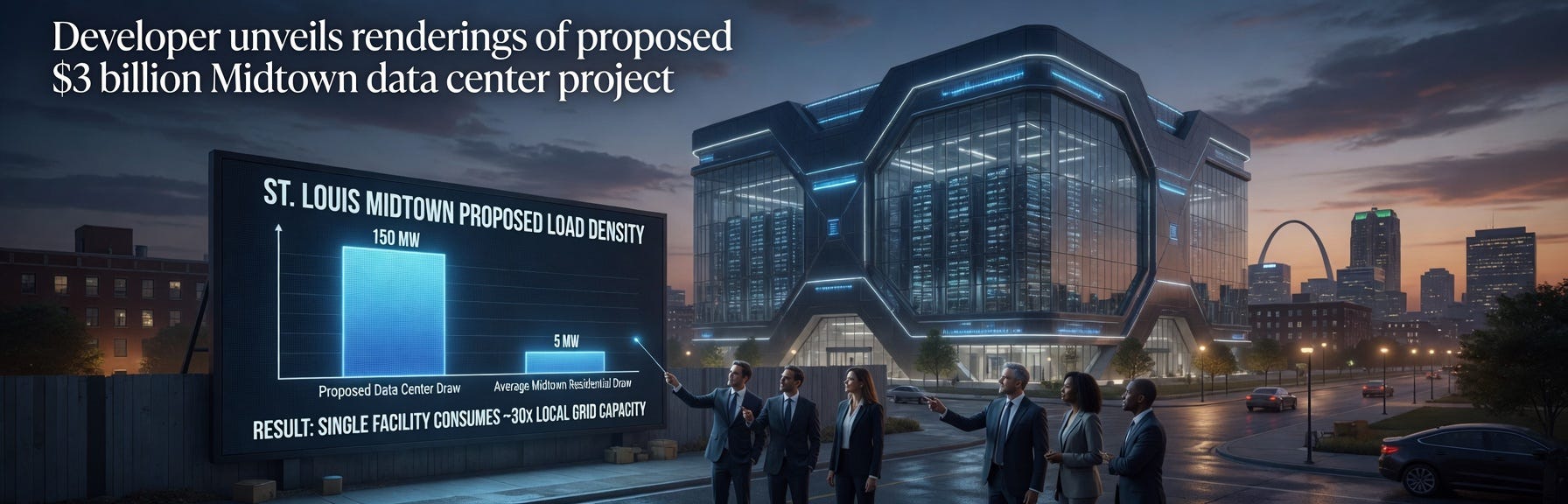
In the glossy digital renderings unveiled by Las Vegas-based developer David Daneshforooz, the corner of Midtown St. Louis near the historic Armory building looks like a vibrant post-industrial playground. Young professionals sit at outdoor cafés beneath manicured trees, while a sleek, modern hotel and apartment tower gleams in the background. It is a cinematic vision of urban revitalization—a picture-perfect synthesis of historic preservation and high-tech abundance.
But walk just a few hundred yards east to the former Famous-Barr warehouse, and the physical reality asserts itself. The brick structure, a massive relic of the city’s department-store glory days, stands silent under the St. Louis sun. The air is warm and smells of damp concrete, train exhaust from the nearby MetroLink tracks, and dry brick dust.
If Daneshforooz’s $3 billion proposal secures final city approval, the quiet interior of this historic warehouse will not be filled with open offices or loft apartments. Instead, it will be gutted to house row after row of high-density server racks.
The manicured trees in the developer’s renderings will not be the primary landscape feature. The true operational anchor will be a massive array of high-capacity industrial chillers and cooling towers, vibrating day and night to keep thousands of AI processing units from melting. The young professionals in the outdoor cafés will be drinking their coffee within earshot of a continuous, high-frequency industrial whine—the unavoidable physical tax of a 120-megawatt data center campus.
To the St. Louis City Hall boosters, the project is a fiscal home run, promised to pour $200 million into the cash-strapped St. Louis Public Schools (SLPS) over ten years. But beneath the institutional toast to “Midtown’s digital future,” lies a stark physical and regulatory reality. The developer did not select this historic site to save St. Louis heritage; he chose it because it sits directly adjacent to a major Ameren Missouri high-voltage substation. It is a tactical grid grab, packaged inside the narrative of historic preservation.
Part 2: The Structural Forensic
To trace the mechanics of this proposed development, we must look past the architectural renderings and analyze the physical load footprints, the historical preservation compromises, and the regulatory architecture of Missouri’s newly enacted energy laws.
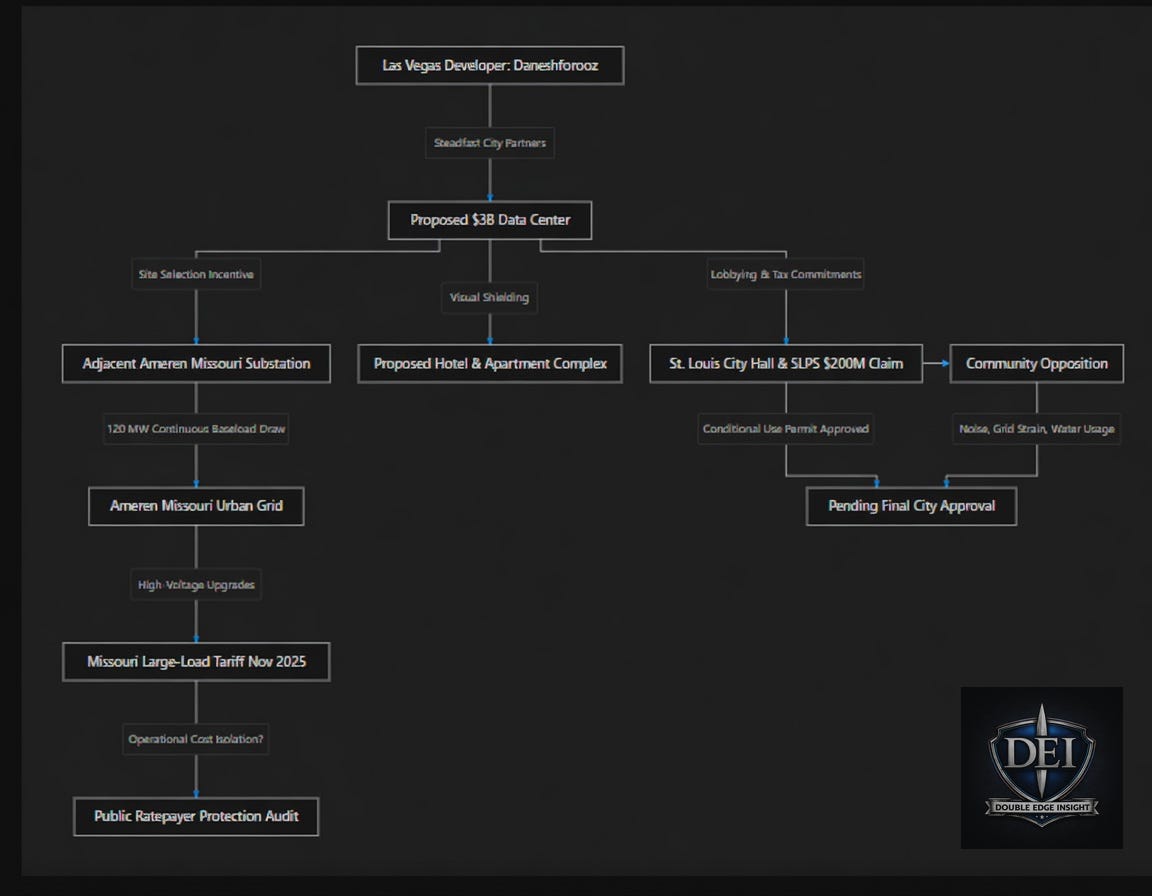
1. The Substation Monopolization (120 MW Baseload)
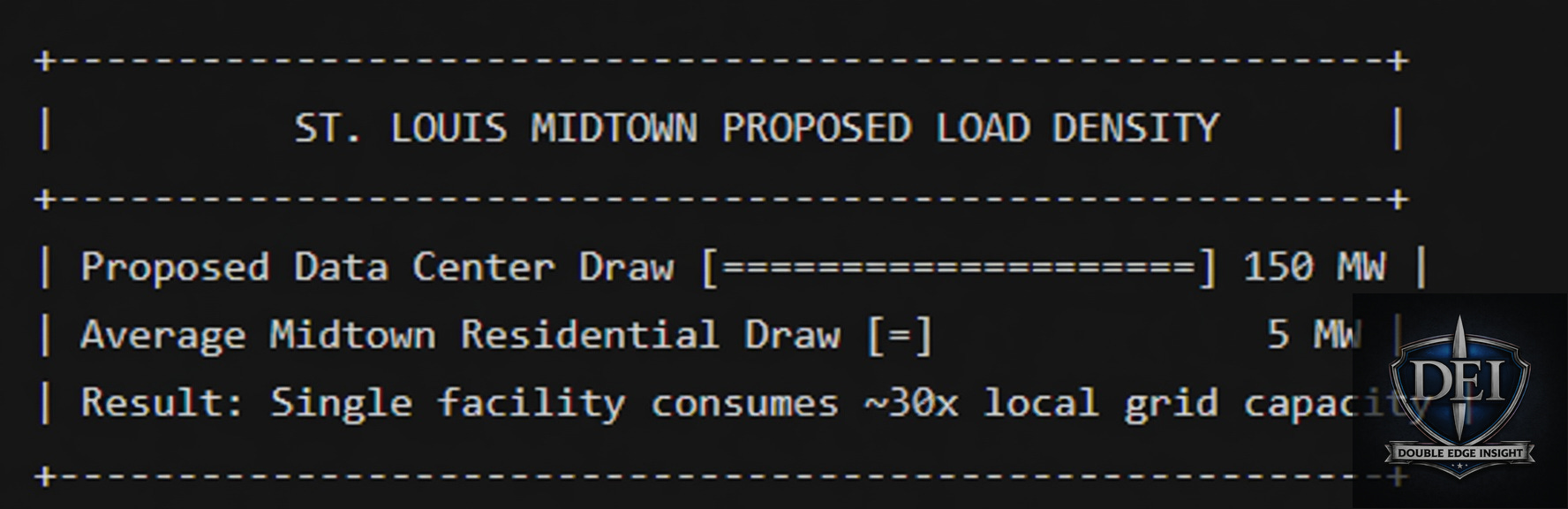
A 120-megawatt (MW) data center is not a light commercial office; it is a heavy industrial electricity sink. 120MW of continuous draw is equivalent to the electrical demand of roughly 90,000 to 100,000 standard American homes.
NOTE
Definition of Reality: Substation Monopolization
Material Referent: The total carrying capacity of the copper transformers and busbars located inside the adjacent Ameren Missouri high-voltage substation.
Operational Reality: While the developer boasts of the site’s proximity to the substation as a capital advantage, a 120MW baseload draw will monopolize the substation’s immediate thermal safety headroom. This effectively crowds out the electrical capacity required for other potential downtown and Midtown developments, prioritizing server cooling over urban residential and commercial growth.
2. The Job Asymmetry and Tax Claims
The proposal promises the creation of over 1,000 temporary construction jobs and 200 permanent jobs, backed by a projected 400millionintaxesandfeesover10years(with200 million earmarked for St. Louis Public Schools). Subjected to our newsroom’s historical baseline audits, these numbers present severe contradictions:
The Construction Loop: Like the Festus Fracture project, high-density construction represents millions of short-term, union-backed labor hours. This explains the strong political push from local building trades.
The Operational Mirage: A standard, fully automated 120MW hyperscale facility typically requires only 30 to 50 permanent staff (security guards, facility managers, and low-level hardware swappers). The claim of “200 permanent jobs” is an extreme anomaly. This figure likely relies on speculative staffing projections from the auxiliary hotel and apartment complexes rather than high-paying, permanent technology roles within the data center itself.
The School Board Shield: Earmarking $200 million for St. Louis Public Schools serves as a powerful “rhetorical shield” to suppress local opposition. It forces community members to argue against school funding if they challenge the data center’s environmental or utility footprint.
3. The Missouri “Large-Load Tariff” Loophole
The developer has publicly highlighted that the project will operate under Missouri’s large-load tariff, a law enacted in November 2025 designed to ensure major industrial energy users pay their own way for infrastructure upgrades rather than shifting the burden onto residential ratepayers.
While presented as consumer protection, the operational reality of large-load tariffs often functions as a regulatory safety valve for utility monopolies like Ameren.
The tariff allows Ameren to secure long-term, high-volume Power Purchase Agreements (PPAs) that guarantee a high rate of return on the new substations and transmission lines built to serve the site.
However, because these specialized lines tie into the broader regional grid, the systemic costs of maintaining the primary transmission backbone are still socialized across the general rate base.
Furthermore, these tariffs rarely account for the opportunity cost of grid capacity. By locking up 120MW of continuous capacity for a private server farm, the utility restricts its ability to accommodate future, high-employment commercial manufacturing without executing massive, ratepayer-funded capital expansions.
Part 3: Operational Reality Matrix
The proposal for the Midtown St. Louis data center presents a classic Symbolic Fracture in the narrative of municipal redevelopment:
DomainInstitutional FramingSurface NarrativeOperational RealityUrban Revitalization“A transformative $3 billion mixed-use development combining historic preservation with high-tech infrastructure, housing, and hospitality.”“Converting an eyesore historic warehouse into a modern digital anchor that revitalizes St. Louis’s Midtown corridor.”gutting a historic brick warehouse to install a windowless, high-noise, and vibration-prone 120MW server farm that physically deadens the surrounding streetscape. [P]Economic Development“Securing 400millionintaxesandfeesover10years,providinga200 million lifeline directly to St. Louis Public Schools.”“Creating 200 permanent high-tech jobs, turning the city into a strategic hub for the artificial intelligence frontier.”The 200-job claim conflates speculative service roles at the proposed hotel with the actual data center workforce, utilizing the school-funding metric to suppress ratepayer and environmental opposition. [S]Grid Accountability“Operating under the November 2025 Large-Load Tariff to ensure the project pays its fair share of infrastructure costs.”“The facility seamlessly integrates with adjacent utility nodes without impacting residential rates or grid stability.”The tariff isolates the developer’s immediate interconnection costs but guarantees the utility massive returns on new high-voltage assets, while socializing long-term regional grid wear and capacity limitations. [C2]
Part 4: Open Forensic Gaps (The MRR Ledger)
To finalize our investigative report on the Midtown Monolith, the following GAPs must be closed:
[GAP: Unredacted Ameren Interconnection Agreement
Material Referent Requirement (MRR): The load contract and system impact study submitted by Steadfast City / Daneshforooz to Ameren Missouri, detailing the exact peak megawatts requested and the thermal upgrade schedule for the Midtown substation.
[GAP: Tax Abatement Schedule
Material Referent Requirement (MRR): The formal petition filed with the St. Louis Board of Aldermen or the St. Louis Development Corporation (SLDC) detailing the exact percentage and duration of the requested property and sales tax abatements.
[GAP: The Large-Load Tariff Execution Sheets
Material Referent Requirement (MRR): The rate sheet filing submitted by Ameren Missouri to the Missouri Public Service Commission (PSC) under the November 2025 large-load tariff guidelines, verifying the exact ratepayer insulation calculations.